
Study in France and its requirements
Study in France, and requirements for acquiring a student visa in France and acquiring a residence permit through study in France will be examined and analyzed in this article. What documents do we need for Study in France? What are the costs of studying and living in French universities? Is the student allowed to work while studying in France? This article has been prepared and written by Malekpour Legal Institute (MIE in Austria) and its aim is to promote the immigration knowledge of your loved ones and companions about Study in France. Dear applicant, for more information on the various areas of your legal immigration, you can contact MIE Institute and benefit from the advice of the most experienced immigration experts for free.
You can also ask your questions in the comments section and receive an answer in a short time.
Topics covered in this article:

Study in France and its general requirements
France is one of the largest countries in Europe. It is bordered by Germany, Belgium and Luxembourg to the northeast, Switzerland and Italy to the southeast, and Spain to the southwest, and England through the English Channel to France. This country is considered a gateway to Europe because it has several major international airports, two of which are located in Paris. France is the most popular tourist destination in the world. There are many reasons why many people enjoy visiting the diverse country of France, including natural beauty, amazing weather, outdoor recreational activities such as golf courses, art museums and galleries, and more. People in France are polite and very formal. The people in this country are also known for being stylish in their appearance and clothes, and some countries consider French citizens arrogant because of these characteristics.
There are 22 official regions in France, each of which is divided into other parts. You can experience all kinds of climates from the north to the south of this vast country. You can‘t talk about France without talking about Paris, the capital of this country. Paris is one of the most magnificent capitals in the world. The Eiffel Tower and the Louvre Museum are located in Paris. Paris is an example of wealth and design, so the region is very expensive. Endless cultural attractions can be found in Paris. More than 60 million people live in the country and French and English are spoken in the country. The currency of France is the Euro. The forestry, fishing, transportation, machinery and tourism industries make up the French economy. There are certainly countless reasons why Study in France is so appealing to people from all over the world, including the lowest tuition fees, the opportunity to explore this amazing country, and the advantage of receiving a degree from the world’s most prestigious academic and educational centers.
Study in schools of France
If you live in France, your child will be allowed with free French education, which is generally of a high standard. The education system in France is divided into several stages. In the following you will see a summary of the French education system, including kindergarten, primary and secondary schools and university. Most students in France enroll in local schools where tuition is free. However, foreign families may consider an international school to facilitate their child’s transfer through continuing Study in a familiar language and curriculum. Although Study in France is compulsory for children between the ages of 6 and 16, many children enter preschool at the age of 3, and more than 50% of people aged 18 to 21 in France are in full-time higher education.
About 64% of students complete their high school education by passing the baccalauréat (le bac) or baccalauréat (le bac prof) exams. Public education is free for French citizens and other long-term residents of France, although parents must pay for stationery and school trips. Schools are coeducational and secular. While most schools are public, there are also private schools under contract with the French government under which the government pays teachers’ salaries. These schools follow the national curriculum and their tuition fees are logical and low. There are also some private schools (ecoles prives) that are completely independent, some of which are international schools. Schools affiliated with a particular religion are also usually private and therefore pay a fee. There are public schools that have bilingual programs, but in most cases bilingual education is only available in private schools.
The school year starts from the beginning of September. French schools have long vacations, including two-month summer vacations starting in July, two or three weeks at Christmas and Easter, as well as mid-term vacations. After kindergarten, which is optional, the French compulsory education system is divided into three stages or cycles:
Kindergartens (écoles maternelles) provide childcare for children from two to three years old to six years old. While children are not obliged to attend, government facilities are free and a great way for young immigrant children to learn French quickly and easily. This course aims to prepare children for primary school and includes reading and writing, numbering and sometimes even in a foreign language.
Children in France attend primary school from the age of six to 11. There are five levels:
- Preparatory period (CP) or ème 11 ages 6 to 7 years
- Elementary course (CE1) or ème 10 ages 7 to 8 years
- Elementary course (CE2) or ème 9 ages 8 to 9 years
- Intermediate course 1 (CM1) or ème 8 age 9 to 10 years
- Intermediate course 2 (CM2) or ème 7 age 10 to 11 years
In primary schools courses on reading, writing, literature, geography, history, and usually a foreign language which is often English, are taught.
Students between the ages of 11 and 15 attend middle school or college in France. They do not need any documents to enter public schools. The curriculum is aimed at all students of general education and consists of French, mathematics, history, geography, civics, biology, physics, technology, art, music and physical education. These materials have been written by the experts of Malekpour Legal Institute (MIE in Austria) and any copying of it without mentioning the source is illegal. There are four levels in the middle school stage:
- 6 ème 11 to 12 years old
- 5 ème 12 to 13 years old
- 4 ème 13 to 14 years old
- 3 ème 14 to 15 years old
At the end of four years at the age of 15, all students must take the test. Students are tested for their knowledge of French, math, history and geography, but they must also pass their B2i (computer / internet skills) throughout the year and reach A2 level in a foreign language. After this test, students may leave the education system if they are 16 years old or continue their Study in high school.
The last three years of secondary school are spent between the ages of 15 and 18 in general, technical or professional high school. Students take the same core curriculum for eight or nine subjects, but they are offered three electives and an art workshop. At the end of the first year, the main decision is made which course the student will follow. Levels are:
- Second (CAP, BEP) 15 to 16 years old
- First (CAP, BEP) 16 to 17 years old
- Final (CAP, BEP) 17 to 18 years
Study undergraduate in France
Undergraduate programs in France can be found in many colleges and universities. For Study in France in bachelor’s degree, you must have a high school diploma or equivalent, as well as meet other requirements. The academic year at a French college or university is from mid-September to the end of June of the following year. Some institutions may also register during the year. If you want to attend a higher Study institution in France, you must arrange your Study in France ahead of time and apply at least two months before the starting date of your course. Recently, France offers many study options for undergraduate students alongside other European countries with English language degrees. Therefore, students no longer need to take a French language course and can actually study at French universities more easily.
There are some useful ways to be eligible for Study in France, such as taking preparatory courses. This type of course allows undergraduate students to take an additional course before starting their program. Try a pre-MBA, pre-law or pre-medical program, as well as other basic or preparatory courses that allow you to study in your chosen major. Improve your English through an English language preparation course. If your goal is to study in France, you need to prove that your language skills are good enough to attend classes and understand lectures. Some universities require a degree in French, while others require strong English skills. These courses prepare you for any of the language tests that universities require.
The duration of study to complete the bachelor’s degree can vary depending on the program to be studied. It is important to note that degrees at many French public universities are usually designed for a maximum of 4 years. However, many other institutions, including universities, also offer short courses that can typically be as short as 2 years. These programs are usually designed to prepare students for specific fields of study. Have been able to continue in the future. The most popular fields of study in France for undergraduate studies include: Business, Humanities and Culture, Engineering and Technology, Information Technology, Literature, Design and Media.
Study postgraduate in France
The master’s degree in France usually takes two years. Unlike the UK Masters, which are a 9-month programs without a break, graduate programs in France are divided into academic years, which are separated by holidays. Educational year in France is for nine months from September or October to May or June. This course is divided into two other semesters with the Christmas holidays. Exams are usually held at the end of semesters. Most French master’s programs also include a similarly developed thesis or research project. This is provided by appropriate research training or practical preparation, and it is usually the culmination of a graduate program. Admission to an undergraduate program in some fields requires an interview, or acquiring a GMAT or GRE score or taking an exam. Depending on the degree, a certificate in French or English is required.
Study PhD in France
Since the enactment of the Bologna Process in 1999, studying in PhD degrees are the third stage of study in France after receiving your diploma. This is usually done after the completion of a master’s degree or diploma similar to the second stage, and it is intended for those students who show significant ability to pursue independent research projects. The French PhD degree, with its emphasis on training professional researchers, is slightly different from that of other countries. Institutions will vary in the way you earn your qualification, but you will typically have to complete several other components alongside your thesis. During the PhD degree, you must take research courses that include teaching sessions and seminars related to your project. These courses which take 150 hours are equivalent a PhD degree. In addition, you may have to hold several training sessions as part of your program.
In addition, you need to do your research to achieve your project goals, which will eventually lead to a thesis. In France, it takes three to six years to complete a PhD degree depending on your major, although there is no legal time limit. In natural sciences and technology (mathematics, physics, chemistry, biology, engineering, etc.) it usually takes three years and can be extended for a fourth year. In the social sciences and humanities (law, management, sociology, history, etc.) it usually takes four to five years. To be admitted to a PhD program, an academic resume and a language certificate related to your program will be important so that you can find a supervisor related to your major and field of study. A language certificate of either IELTS 7 (In English) or c1 in French is required.
If your resume is strong, you can benefit from free education and receiving a scholarship or during your studies, you will receive a salary for your PhD research with an employment contract.
Study in France and its scholarships
France has become one of the most popular educational destinations for international students. However, the cost of studying and living in France is not always affordable. Although the annual tuition at public universities is from 200 to 600 euros, at private universities it can reach 10,000 euros. The cost of living is about 10,000 euros per year. Fortunately, there are a number of French scholarships offered to international students. The French Ministry of Higher Education and Research also grants scholarships to some international students based on some social criteria. To be eligible, students must have resided in France for at least two years and pay taxes in France. This ministry also secures doctoral contracts run by doctoral schools.
In France, public research is divided between higher Study institutions and government agencies such as the CNRS (National Center for Scientific Research), the IRD (Research and Development Institute), the ADEME (Environmental and Energy Control Agency), the IFREME Agency and the French Maritime Research Institute). Becomes. These public institutions, in cooperation with the regions, provide research funding for PhD students.
| Higher Education scholarships | The Eiffel Scholarship Program is developed by the Ministry of Foreign Affairs as a means of enabling French higher Study institutions to attract the best international students for masters’ and PhD programs. Eiffel Scholarship holders receive a grant of € 1,181 for master’s programs and € 1,400 for Scholarship holders for PhD programs. In addition, the program comes with a variety of costs, including return travel, health insurance and cultural activities. Scholarship holders may also be eligible for additional accommodation. This scholarship does not include tuition. |
| École Normale Supérieure International Selection | Each year, the ENS makes an international selection of 30 top international students in the sciences or humanities to take a two- or three-year program at the ENS. They receive approximately € 1,000 a month for 2-3 years. About 30 international students are awarded each year. |
| Ampere Scholarships of Excellence at ENS de Lyon | ENS de Lyon and its partners offer scholarships to top international students so that they can enroll in their master’s programs in science, art and the humanities and social sciences, with the exception of a professional master’s degree in education, and receive Ampere Excellence Scholarships. Scholarships cover € 1,000 per month for a period of 12 months and can be extended. |
| Emily Boutmy Scholarships at Sciences Po University | Poe Science After founding Poe Sciences (Humanities such as Political Science, International Relations or Social Sciences), he created Emile Boutmy Scholarships to bring in the best international students from outside the European Union who are already applying and already at Poe University. Scholarships can range from € 5,000 to € 10,000 for 2 years of postgraduate study or from € 5,000 to € 10,000 for 3 years of undergraduate study. |
| Université Paris-Saclay International Master’s Scholarships | Université Paris-Saclay wants to increase access to its master’s degree programs to international students who are taught at its member institutions. An annual scholarship of € 10,000 and a maximum of € 1,000 for travel and visas are also granted. |
| Grenoble Institute of Technology Foundation Scholarships | The Grenoble Institute of Technology Foundation supports a scholarship program for international students wishing to study in France for an international master’s degree at the Grenoble INP. This grant is € 5,000 per semester. |
| INSEAD MBA Scholarships | INSEAD scholarships are limited in number and there is considerable competition for each award. These scholarships are awarded according to different criteria and fall into two main categories: need-based and non-need-based (based on both qualifications, nationality, gender, professional background, leadership abilities, background of previous studies, etc.). Scholarships range in value from $ 5,000 to $ 25,000. |
| HEC Paris MBA Scholarships | HEC Paris offers large scholarships to international students from different countries and backgrounds. HEC scholarships fall into several categories: based on competency, based on need, or based on specific criteria. Scholarships range from € 6,000 to € 24,000. |
Study in France and costs of study and living in France
In this part of the article which is about Study in France, we will review university tuition and the average cost of living in France so that you can have an accurate assessment of the amount of financial capability required for immigration through study in France.
| Tuition at other higher Study institutions | International students pay a special fee (in schools and higher Study institutions) in France, which is around 500-600 euros per year. But in some cases, they can cost up to € 10,000 a year. Tuition for private universities starts at € 1,500 and can be over € 20,000 per year. In business schools, regardless of the level of the degree, the costs are between 5 and 30 thousand euros per year. |
| Keep in mind that tuition at public universities often applies only to EU students EEA and Switzerland. If you are a non-EU citizen, you may be more expensive to study. To avoid confusion or future problems, go to the University Program page and check whether tuition is applied for your country’s students. | |
| Average cost of living in France | The total cost of living in France depends on your lifestyle and, most importantly, your chosen location. Mostly the city where you live in France can be decisive. The average budget required for each French city is discussed below.
Paris: between € 1,200 and € 1,800 per month including accommodation. If you decide to live in a student dormitory: Good: Between 900 and 1400 euros per month Lyon, Nantes, Bordeaux or Toulouse: between 800 and 1000 Euros For the rest of the cities in France, you can manage for less (at least € 650). |
| Accommodation prices are usually higher than the international average of € 200-300 per month. | |
| The main options for student housing to study in France | Student dormitories: they are around an average of € 200 per month. Paris is an exception, with 400 euros a month. About 13% of international students live in dormitories. This is one of the most popular accommodation options among students, but the demand is far greater than the supply.
Rent / share an apartment: It costs between 400 and 700 euros per month (800 euros per month in Paris), while in smaller French cities you can rent a small apartment for around 300 euros per month. If you live with your partner or child, the rental price varies from 700 to 1000 euros per month, and if you choose an apartment in the city center, you can pay a higher fee. The utility bill (electricity, water, and internet) will be € 200 per month. Host family: You can have rates that are only € 200 per month to around € 800 per month in Paris. |
| International students also have access to VISALE, a plan that acts as a guarantor. The guarantor is someone who will pay for your rent if you can no longer do so. However, the VISALE program only helps international students who rent an apartment / room in a university dormitory. | |
| Costs of Food in France | An average person can spend around € 250-300 per month on food in Paris or less in other provinces. The average price of a meal in the cheapest restaurant is between 10 and 15 euros. In gourmet restaurants, menus can be more expensive. A more affordable option where you can eat anywhere in France is the bistro, rice and crepe stalls. Some bistros serve substantial meals, and a crepe can be eaten as lunch, and the prices are from 5 to 8 euros. |
| Transportation costs | Monthly travel by bus, metro or tram is usually between 30 and 75 euros.
Taxis are also relatively cheap in Paris (around € 1.50 per kilometer) and you pay € 7 to € 10 for a short trip. You can rent a bicycle through the Vélib Bicycle Rental app. In France, Bordeaux is the friendliest city by bike. You can also use the TGV to travel to other cities in France for around € 30. |
| Additional costs and savings | Depending on the insurance coverage chosen, health insurance costs 20 to 50 euros per month.
Books or other learning materials cost around € 50 per month. If you buy an international youth travel card, you can get major discounts for sightseeing around France. |
Study in France and student jobs while studying in France
You can increase your income by working while studying in France, regardless of your level of education or nationality. In France, every student has the right to work in a company or university. Here are some rules to help you learn more. If you are not an EU citizen, you must have a student residence permit. French law allows foreign students to work as students for up to 964 hours a year, which is equivalent to 60% of full-time work in France. The amount of student work can only be a supplement to your income. When you work in France, whether you are a student or not, your minimum wage is guaranteed by law. Job income from January 1, 2018 is € 9.76 gross per hour. This is gross wages and you have to deduct mandatory social costs (about 20%) from it, resulting in your net income of 7.61 euros per hour. If you work 10 hours a week for the minimum wage, you will have a net weekly income of around € 78.
In France, international students may also work at their host institution or university. These employment contracts for students for a maximum of twelve months run from September 1st to August 31st. Student admissions are at the beginning of the educational year, teaching, cultural or sports activities, helping students with disabilities and they are generally for activities that contribute to the welfare and social atmosphere of the university. In order to help students succeed and find work afterwards, student work at a university is compatible with their schedules and classes. For this reason, students working at French universities may not work more than 670 hours from September 1 to June 30 and more than 300 hours from July 1 to August 31. As part of the preparation process for the educational stages, the student must complete an internship. French and international students are subject to these rules:
The number of working hours while studying in France is 10 hours per week for bachelor’s degree, 20 hours per week for master’s degree and 30 hours per week for PhD degree.
Study in France and dependent visa
If you have started a family in your country of origin, you can apply to join a relative or partner in France on a family dependent visa, provided you meet certain conditions. It depends on several factors, such as your nationality, the type of residence your relatives have, and how long they have lived there. Spouse and young children under the age of 18 who are not members of the European Union (EU) and the EEA of Swiss citizens can apply under the following conditions:.
If the application is successful, you can join one of your relatives in France and for this you need to acquire a long-residence visa. The French visa system is issued by the embassy or consulate in your home country and is valid for one year, then it will be converted into a residence card (VLS-TS). Visa is free. You must arrive in France within 3 months of receiving your visa and must register with the local office OFII (Office Français de l’Immigration et de l’Intégration) within two months of arriving in France. If you have lived in France for more than a year, you must apply for a residence card (Cartier de Seure). Medical examination must be performed after arrival in France (for residents of Armenia, Cameroon, Mali, Morocco, Senegal, Tunisia and Turkey, this must be done before entering France from their home country)
Study in France and introducing top universities of France
If you want to study in France, you need to know which universities are among the best. According to the Times Higher Education’s Rankings 2020, 38 French institutions are among the top universities in the world. The ranking includes 9 institutions in Paris, which is the best city in France, and other options scattered throughout France. In the following, we will name the top 5 universities in France.
| Name of universities | Related Information |
| PSL Research University | Ranked 53rd in the world and ranked first among the top French universities, PSL Research University, a university founded in 2010 and consisting of 9 founding colleges, including the Olecole Normale Supérieure (ENS) in Paris. This university achieves the highest scores in employer reputation and faculty-student ratio indicators, and establishes strong links with employers as well as strategic partnerships with other reputable universities around the world. |
| École Polytechnique (Paris Tech) | Ranked 60th in the world in 2020 and a founding member of ParisTech who specializes in theoretical science and business programs. The campus, 30 km outside the city center of Paris, has 120 hectares of green space for more 4,600 students to enjoy. |
| Sorbonne University | A new institution that combines the University of Paris Sorbonne with the University of Pierre and Marie Curie, the Sorbonne is ranked 77th in the world by 2020 and is one of the top six universities in the university reputation index. |
| CentraleSupélec | It was ranked 139th in the world in 2020, and since 2015 it has been a merger of the Ecole’s central Paris and the Graduate School of Electrical Engineering in Paris, and is a founding member of the Saclay University of Paris, the French Association of Intensive Research Universities. |
| École Normale Supérieure de Lyon | Ranked 160th in the world this year (2020), it still ranks fifth among the top universities in France. The university is another high Study institute, a model public institution that trains researchers and teachers in the humanities and social sciences. |
Study in France and requirements for acquiring student visa
For Study in France, you must apply for a visa if you residency for more than 90 days. You must provide proof of admission to your chosen academic center in France. The documents you must submit to the embassy to acquire a student visa in France are listed below:

Study in France and post-study work permit opportunities
If you have dreamed of getting a degree in your favorite major in France since you were a child, staying in this country after graduation should be on your wish list. Most international students look for employment opportunities to take advantage of job opportunities in France, and sometimes in the city of their graduation and university, but they face the problem of lack of jobs, having global competitors and various factors. Therefore, after graduation in France and for working in France it is very important that you are familiar with the rules and regulations. If you have residency in France for a short language course of less than 1 year, you should know that you will not be allowed to work after graduation in France and you will not be able to extend your visa and you will have to leave the country. Graduate students after graduation in France can stay in the country for 2 years and enter the job market.
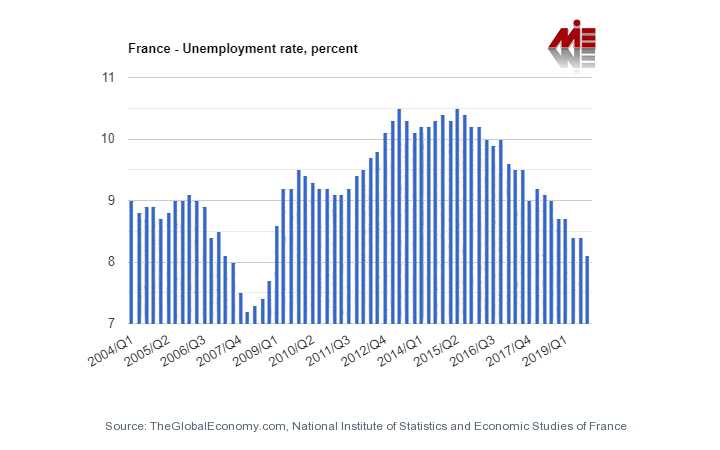
Note that there is no permission to work after completing a bachelor’s degree, and you must be able to find an employer before completing your studies in France. In the chart below, you can see the unemployment rate in France in different years. Unemployment rate in 2019 for France is 9.1 percent, which is higher than Germany, Austria
Study in France and requirements for acquiring post-study residency and citizenship
One of the most important and fundamental questions of many applicants for Study in France is the conditions for acquiring permanent residence and acquiring a French passport. By studying in France, you have a good opportunity to enter the process of acquiring permanent residence in this country by converting your study residence into work residence. According to EU law, if you can work in France for 5 years and pay taxes, you can become a permanent resident. You can apply for a French passport if you can prove things such as no criminal record, paying taxes, learning French and adapting to the culture of this country.
We need to remind you that by acquiring permanent residence in France, you will have all the effects of citizenship and you can not only be involved in the political decisions of the country, but other citizenship facilities are also considered for you. Your family and children benefit from studying in France for free, there will be health and insurance services for the family, you can use the banking and financial services of France.
Answers to frequently asked questions about Study in France
✅Is Study in the France free?
If you study in French, you can study at free universities.
✅Is it possible to study in France without a language certificate?
Yes. You can take a language course in France.
✅Is it possible to acquire scholarships from universities of France?
Scholarships are usually granted to PhD students and you must present a strong resume including high language scores, and published papers in outstanding international scientific journals, and also high grades and GPA.
✅Is it possible to work in France after graduation?
After graduation you will be given the opportunity to look for a job in France. If you are hired in a suitable job, you can change your residence to work type.
Leave a Reply
Want to join the discussion?Feel free to contribute!